The Problem
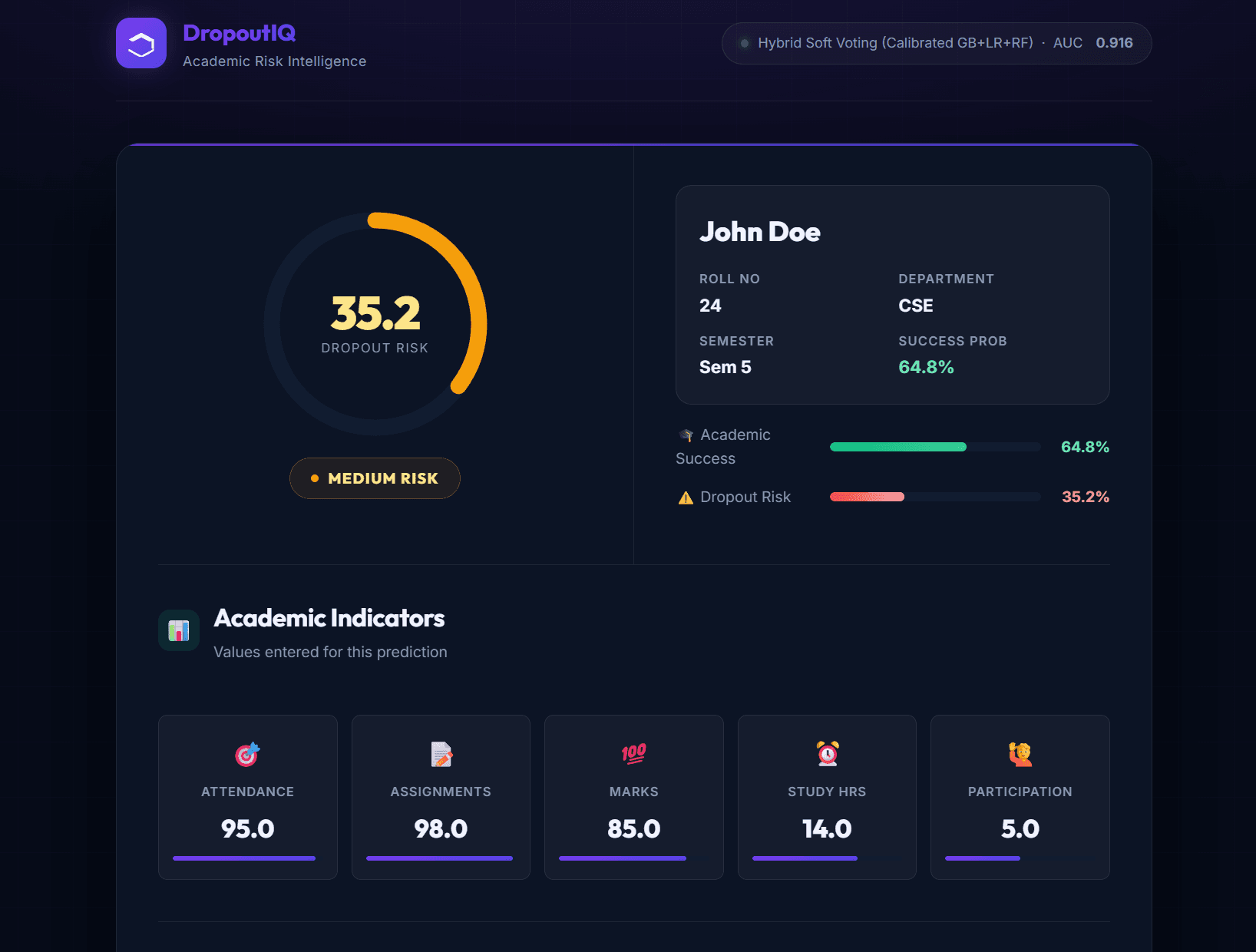
Student dropout is a critical challenge in higher education, leading to wasted institutional resources and lost potential. Early identification of at-risk students enables timely intervention, but manual identification is subjective and inconsistent. The challenge is building an accurate, calibrated prediction system that minimizes false negatives (missing at-risk students) while providing real-time risk scoring accessible to administrators through a web interface.
Architecture & Approach
The system uses a Hybrid Soft-Voting Ensemble combining Gradient Boosting, Logistic Regression, and Random Forest classifiers with calibrated probability outputs. Feature engineering includes Pandas-driven preprocessing, automated feature selection, and systematic hyperparameter tuning. The trained model is served through a Flask-based REST API that accepts student data and returns real-time dropout risk scores. The ensemble approach was chosen over single models to reduce variance and improve calibration, critical for minimizing false-negative risk flags in academic intervention contexts.
About the Project
A student dropout and academic-risk prediction system powered by a Hybrid Soft-Voting Ensemble of Gradient Boosting, Logistic Regression, and Random Forest, achieving 92.8% ROC-AUC. Architected as a Flask-based REST web application for real-time dropout risk scoring, with Pandas-driven feature preprocessing, feature selection, and hyperparameter tuning to minimize false-negative risk flags for early academic intervention.
Key Metrics
92.8%
ROC-AUC
Calibrated Soft-Voting Ensemble
Model Type
Gradient Boosting + Logistic Regression + Random Forest
Classifiers
Flask REST web application
Interface