The Problem
Long news articles and government releases are difficult to review quickly, while concise summaries must preserve important entities, dates, percentages, and policy details. PrecisAI compares extractive and abstractive approaches and evaluates how well they transfer from news data to real government documents.
Architecture & Approach
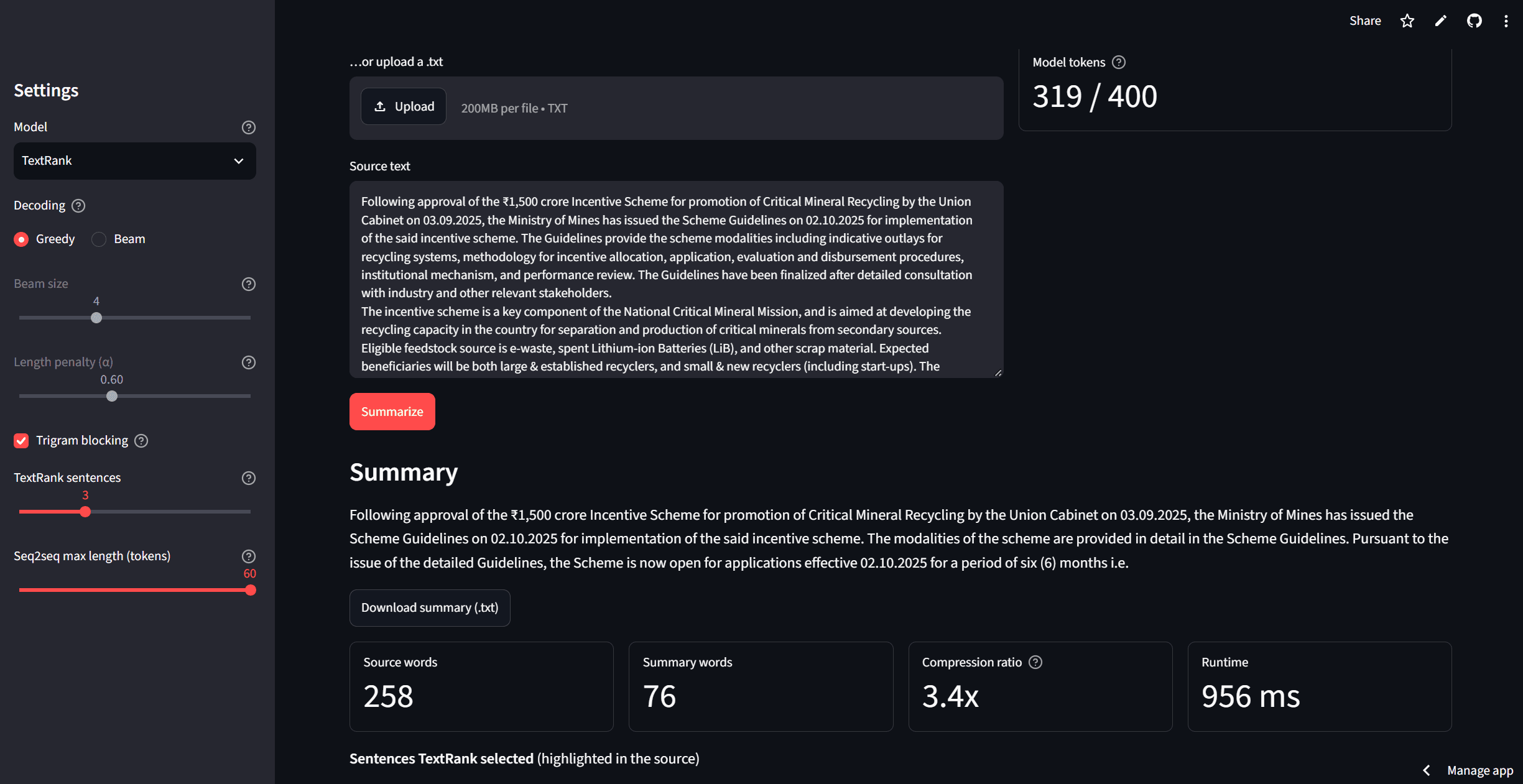
The extractive pipeline builds a TF-IDF sentence similarity graph and ranks sentences with TextRank. The neural pipeline pairs a bidirectional GRU encoder with a GRUCell decoder and compares Bahdanau additive attention, Luong general attention, and a no-attention baseline. Greedy, beam, top-k, and nucleus decoding are evaluated alongside pretrained T5 and BERT-based extractive options. A Streamlit dashboard brings together CNN/DailyMail evaluation, government document summarization, attention heatmaps, and lexical policy-preservation audits.
About the Project
An end-to-end text summarization platform combining graph-based TextRank with a from-scratch PyTorch BiGRU–GRU sequence-to-sequence model. Compares Bahdanau and Luong attention, tuned beam and sampling decoders, and pretrained transformer baselines, with evaluation on CNN/DailyMail and zero-shot transfer to Indian government circulars. Includes an interactive Streamlit dashboard with attention heatmaps, compression metrics, and policy-preservation audits.
Key Metrics
30.61
Tuned Beam 4 ROUGE-1
9.17 / 20.41
Tuned Beam 6 ROUGE-2 / ROUGE-L
9 official documents
Government Benchmark
From-scratch BiGRU + GRU
Neural Model